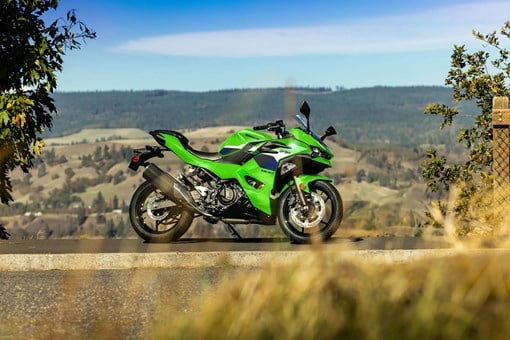
Kawasaki Ninja 500 2026 specs and score
The friendly face of the A2 sports class, now with real midrange.
60.0/ 100
Scored within supersport, methodology here
€6,595
list price
- power
- 45.4 hp
- wet weight
- 171 kg
- tank range
- 359 km
The short version
The Ninja 500 grew the old 400's twin to 451 cc for usable torque at 6,000 rpm, kept the famously light clutch and low 785 mm seat, and added Kawasaki's four year warranty. It skips the electronics arms race entirely, which is either its weakness or its entire point.
Where it wins
- Torquey 451 cc twin flatters new riders where rivals demand revs
- 785 mm seat and 171 kg make it the most accessible A2 sports bike
- Four year warranty doubles what most rivals offer
Where it loses
- No traction control, ride modes or TFT on the base model at any price
- Basic suspension and a two-piston front brake trail the KTM's hardware
Score breakdown
Engine and performance
13.9 / 25Handling and chassis
10.3 / 20Value
16.0 / 20Practicality
8.7 / 15Technology
1.8 / 10Reliability and ownership
9.3 / 10The full review
What the extra capacity fixed
The Ninja 400 was the friendly one that needed revving; the 500's extra 52 cc moved peak torque down to 6,000 rpm and reviewers immediately noticed the difference in town and out of slow corners. The consensus calls it the easiest A2 sports bike to ride quickly, with a clutch and throttle so light that first-bike nerves simply have nothing to grab onto.
At 171 kg wet with a 785 mm seat, it is the machine short riders and new licence holders keep ending up on, and the press keeps concluding that is no accident.
What Kawasaki left out
The base bike has no traction control, no ride modes, no quickshifter and an LCD dash; the SE trim adds a TFT with connectivity but not the electronics. Against the KTM RC 390's cornering ABS and adjustable suspension, or the Aprilia's modes and aluminium frame, the spec sheet reads a generation behind.
The counterargument is the ownership maths: services every 12,000 km, a four year warranty no rival matches, and Kawasaki's small twins have a reliability record that makes the missing electronics feel less like a gap and more like fewer things to break.
Ninja 500 or the sharper rivals
As a track-day starter the RC 390 and RS 457 are simply better tools, with hardware and electronics the Kawasaki does not attempt. As a first sports bike ridden year-round, the Ninja's soft edges, low seat and long warranty win the argument more often than the spec sheet suggests.
The press verdicts land where mine does: it gives away points on paper and takes them back at the dealer. Buy it for what it is, the gentlest way into sports bikes, and it will not disappoint; buy it to chase Aprilias and it will.
Full specs
| Engine | |
|---|---|
| Engine | Parallel twin, liquid cooled, DOHC |
| Displacement | 451 cc |
| Power | 45.4 hp at 9,000 rpm |
| Torque | 42.6 Nm at 6,000 rpm |
| Power to weight | 0.27 hp/kg |
| Chassis | |
| Wet weight | 171 kg |
| Front suspension | 41 mm telescopic fork, 120 mm |
| Front adjustability | Non-adjustable |
| Rear suspension | Monoshock, 130 mm |
| Rear adjustability | Preload only |
| Front brake | 310 mm, axial 2-piston |
| ABS | Standard ABS |
| Dimensions | |
| Seat height | 785 mm |
| Wheelbase | 1375 mm |
| Fuel capacity | 14 L |
| Claimed consumption | 3.9 L/100 km |
| Fuel range | 359 km |
| Ownership | |
| Price | €6,595 |
| Service interval | 12,000 km |
| Valve check | 24,000 km |
| Warranty | 4 years |
| Equipment | |
| Dash | LCD |
| Ride modes | No |
| Traction control | No |
| Quickshifter | Not available |
| Cruise control | Not available |
| Connectivity | No |
Compare the Ninja 500
Every head to head this bike has a page for: its own class first, then the cross-class matchups buyers actually weigh up.
Frequently asked
- Is the Kawasaki Ninja 500 A2 licence legal?
- Yes. The Kawasaki Ninja 500 makes 45.4 hp (33.4 kW), inside the 35 kW A2 ceiling, so it is sold A2 compliant with no restriction kit required.
- How fast is the Kawasaki Ninja 500?
- Our power-to-weight model estimates 0 to 100 km/h in about 5.7 seconds, from 45.4 hp moving 171 kg wet. That is an estimate for comparison, not a measured time, and it is labelled that way everywhere on this site.
- What is the fuel range of the Kawasaki Ninja 500?
- About 359 km on paper: a 14 litre tank against a claimed 3.9 L/100 km. Ride it with enthusiasm and the maths gets worse, never better.
- How tall is the seat on the Kawasaki Ninja 500?
- The Kawasaki Ninja 500 seat sits at 785 mm, which is one of the most accessible perches in its class, so most riders get both feet down. At 171 kg wet, weight does the rest of the talking at a standstill.
- How much does the Kawasaki Ninja 500 cost?
- €6,595 list price in the EU market this site scores. It earns 16 of 20 value points on our formula, which weighs price against equipment and running costs.
The workshop
Build your Ninja 500
The upgrades owners actually fit, at typical retail prices. Tap a part to bolt it on and I re-run the full 100-point scorecard on your build, same math as the official score above. Shop links are affiliate links: they support the site and cost you nothing extra.